
European pellet market: voices, data and scenarios at the European Pellet Forum 2026
Production, consumption, prices, regulations and supply chains: the European pellet market will be in the spotlight at the European Pellet Forum 2026.
International speakers will unveil exclusive data, provide in-depth analysis of trade flows, focus on premium and industrial pellets, explore new sourcing areas, examine EU regulatory scenarios, and outline future prospects for stoves, boilers and distribution in Europe and Italy.
The European pellet market is undergoing a phase of profound transformation, shaped by new supply dynamics, price volatility, regulatory updates and a rebalancing between the residential and industrial segments.
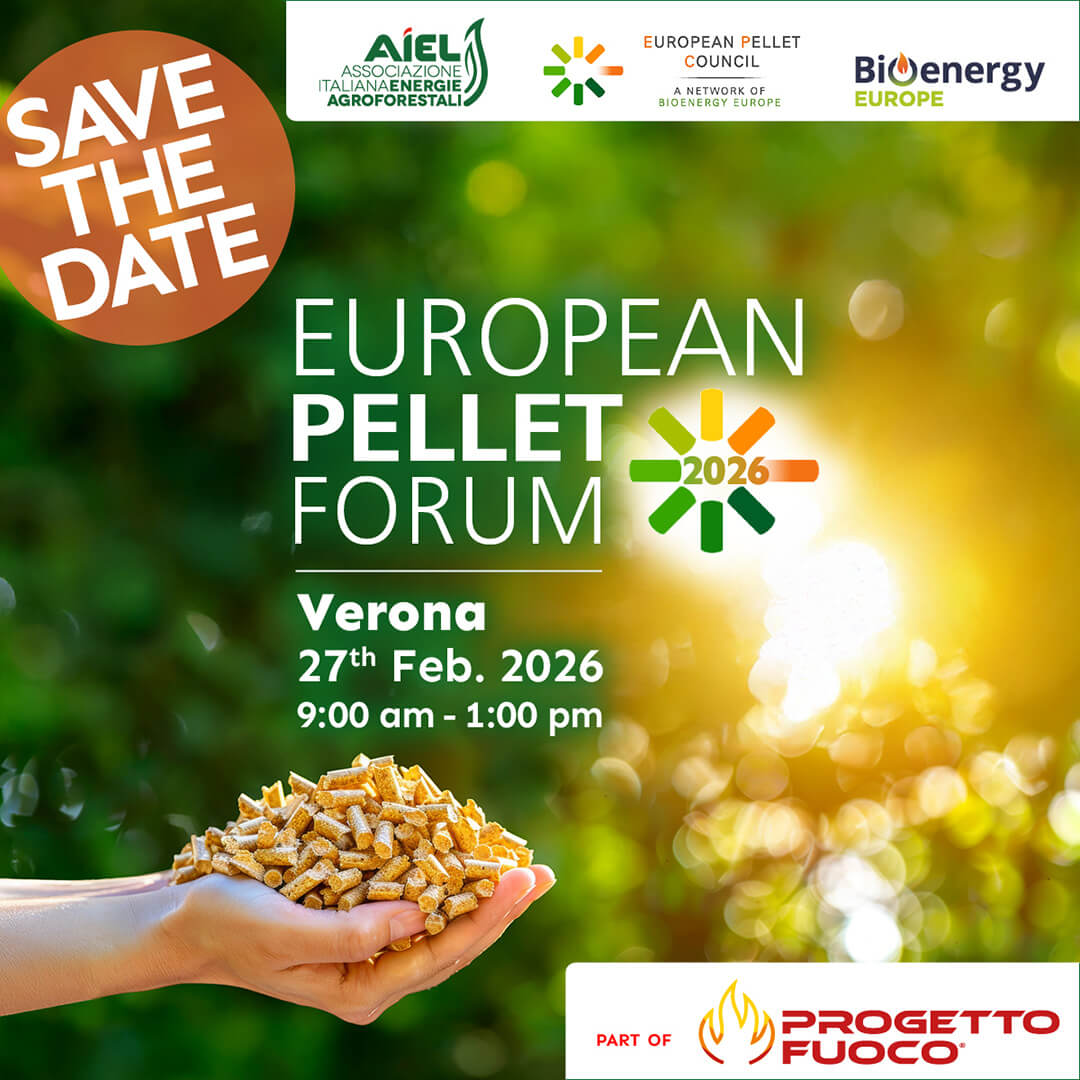
At the European Pellet Forum 2026, scheduled for 27 February alongside the Progetto Fuoco trade fair in Verona, analysts, market players and representatives of the international supply chain will provide insights based on up-to-date data, concrete scenarios and development perspectives for both the Italian and European markets.
Here is an early insight about their presentations. Visit the official website of the event and consult the programme.
European pellet market dynamics and future trends
 |
Manolis Karampinis, Bioenergy Europe I will deliver a high-level overview of the European pellet market, highlighting key statistics on production, consumption, trade flows, and price dynamics, along with expected future trends. I will focus on premium and residential pellet segments, with a focus on key markets that are closely interconnected with the Italian pellet market. I will also present an update on pellet appliance sales (stoves and boilers) across Europe, since this is a key factor influencing the organic growth of the pellet sector. |
 |
Matteo Favero, AIEL Which regions consume the most pellets? Do market shares for non-certified or A2-grade pellets still persist? From how many and which countries, and from which suppliers, do Italian traders source their pellets? How fast is domestic production growing? How many bagging plants are there, and where are they located? And how can the traditional retail channel respond to the pressure from large-scale retail chains? I will address these and many other questions, using highly up-to-date and previously unpublished data. |
 |
Gilles Gauthier, Hawkins Wright The global and European demand for industrial pellets significantly influences the dynamics of the premium segment. I will analyse the most recent trends and the outlook for the industrial sector, also considering the imminent conclusion of the former incentive schemes for power plants in the United Kingdom and The Netherlands. How will this overcapacity of industrial pellets influence the pellet market? |
Global supply chains and raw material availability
 |
Jose Carlos Haas Junior, Haas Madeiras Brazil has established itself as a growing and reliable supplier of wood pellets to Europe, and particularly to Italy. However, recent national and global events have reshaped this supply chain, creating both new opportunities and emerging challenges. I’ll give you access to the latest market insights and assess their consequences to understand the present and be ready for the future. |
 |
Daniela Espinoza Navarrete, ACHBIOM I will present an overview of the Chilean pellet market from the perspective of the Chilean Biomass Association, which represents the leading pellet producers in Chile. The presentation will cover the current market status, key figures, main challenges, and development opportunities. I will also explore areas of interaction with the Italian market, analysing trends and potential synergies between the two countries. |
 |
Diego Benedetti, EOS The European sawmill industry is the primary processor of sustainably sourced European logs, and its by-products represent a crucial feedstock for renewable bioenergy production. I will outline the latest trends in the sawnwood market and provide an outlook for the coming months, considering the combined impact of global geopolitical and economic dynamics, as well as local market-specific factors. |
 |
Irene Di Padua, Bioenergy Europe The future of pellet markets will not just depend on technological aspects but also on legislation. EUDR, RED III and Ecodesign are already redefining which feedstocks are acceptable, which installations are viable and which business models can scale. My intervention will unpack the real implications behind these acronyms: where the main risks lie, where opportunities are emerging, and what the pellet value chain must do now to stay ahead of EU rules rather than chase them. |
The main challenges for the pellet industry
 |
Paolo Liedholm, LCA Studio Legale The European Single Market has opened new business opportunities, but it has also facilitated the spread of illicit practices with significant impacts on companies, the market, and society. Among these, carousel fraud and related tax evasion represent one of the most insidious risks. In this context, the establishment of the EPPO, the new “European Public Prosecutor’s Office,” is particularly relevant, having included VAT fraud among its operational priorities. I will analyse the current regulatory framework, highlighting how risks can also affect operators acting in good faith, who may face challenges related to tax deductions, recoveries, and even criminal liability. In this scenario, tax compliance and the assessment of clients and suppliers become essential tools: in many cases, the very survival of the company is at stake. |
 |
Martin Englisch, BEA Spruce is a unique and highly valuable tree species. It grows straight and is easy to debark, making it ideal as construction timber and thus the most important wood in the timber industry. Its wood is almost white, has excellent burning properties, and a low ash content. This also makes it ideal as a raw material for high-quality pellets. There is only one small problem: spruce cannot withstand changing climatic conditions and its numbers are declining. Are there alternatives in the pellet industry? |
 |
Didzis Palejs, LATbio A good person takes care about family and everything surrounding it. Do we care about wellbeing of our industry? What are the ways how we can take care about our industry? Let’s all together dive out from our daily routine, open our eyes and see the “big picture”. |
Pellet stoves and boilers: between resilience and revolution
 |
Annalisa Paniz, AIEL The Italian classification framework for pellet stoves and boilers is still evolving. National limits are being progressively tightened to address the challenges posed by new European air quality regulations. The classification system is expected to expand further, while seeking a new balance among the required parameters. However, this growth does not necessarily imply stricter limits at every stage. The future of the system lies in the stabilization of the classification scheme, where the introduction of a new class does not automatically imply market restrictions. |
Roundtable: shaping the future of the pellet sector
 |
Riccardo Zanette, MCZ Group For over twenty years, a pellet heating supply chain has been growing in Italy, bringing sustainable warmth to homes across Europe every winter. Sustainable for the environment, for modern lifestyles, and for European families’ budgets. Institutions and stakeholders do not just have the opportunity to support and promote this excellence – they have a duty to safeguard it. |
 |
Alessandro Pretolani, Adriacoke Commodities Srl In an increasingly volatile pellet market, bulk pellet imports by sea vessels represent a strategic alternative to traditional supply chains. Maintaining physical stock in Italy reduces the risk of supply interruptions, stabilises prices, and strengthens energy security. I will bring the experience of Adriacoke Commodities Srl, which has been leader for over 15 years in both supply volumes and continuity. |
 |
Maurizio Annovati, Alpinpellet Sas Since 2025, France has become a strategic partner for the Italian pellet market. Production at our facilities is steadily increasing, supported by 25 years of logistical expertise that enable the reliable handling of large volumes. Thanks to storage capacity in both France and Italy, we ensure year-round availability of high-quality pellets. Alpinpellet and its partners will be your pellet solution for the months ahead. |
 |
Nicole Florian, Florian Group I will present the pellet market from the supply chain perspective – that of the Florian Group. We are a European leader in hardwood processing, with 18 companies and a zero-waste production chain. An integrated supply chain that tackles the challenges of the pellet market with quality, industrial scale, and long-term vision. |
 |
Pietro Di Sarno, Green Alliance I will present the pellet market from the perspective of Green Alliance, a leading operator in Italy and a growing presence in Europe in the distribution of biofuels for domestic and industrial heating. In a sector characterized by highly fragmented demand and supply, we coordinate a broad strategic alliance, ensuring high reliability across the entire supply chain. In this way, we contribute to decarbonisation, supporting the European Green Deal 2030 objectives. |
 |
Stefano Lanciotti, Windhager Italy Srl Pellet boilers are becoming increasingly advanced, with high efficiency and almost zero emissions. But for them to truly become a solution within everyone’s reach and have a real positive impact on the environment, there is one fundamental condition: pellet must be affordable and have stable in prices. This is the path toward a more sustainable, zero-emissions future. |
How to Participate
If you want to explore these topics in depth, engage with key players in the supply chain, and understand how the European pellet market will evolve, the event to attend is Progetto Fuoco. Join the European Pellet Forum and gain access to data, analyses, and scenarios useful for guiding your decisions in the sector.