
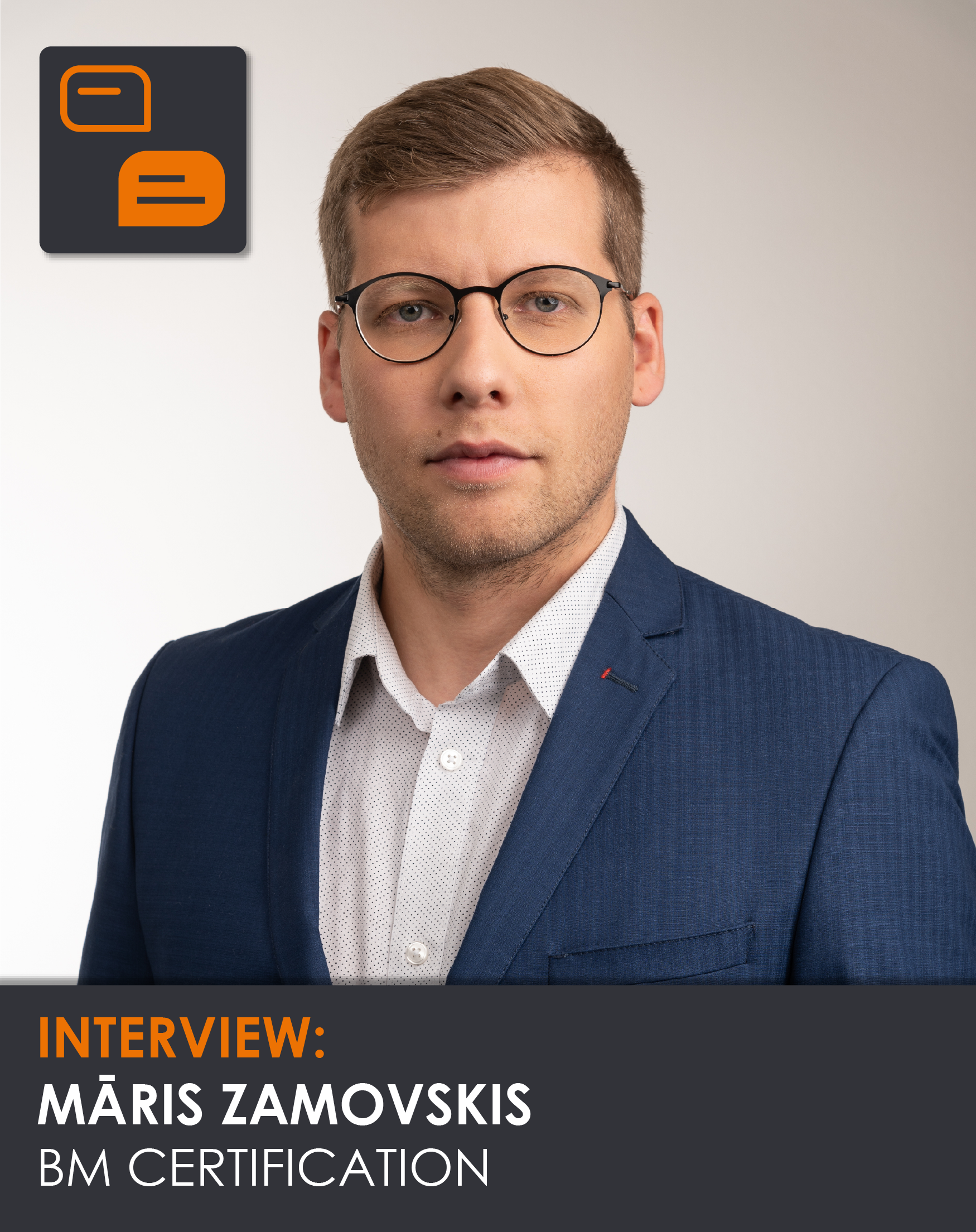
Māris Zamovskis from BM Certification: “Our goal is to be a reliable long-term certification partner.”
For BM Certification, certification is about more than assessing compliance; it is about helping companies grow, improve, and earn market confidence. Māris Zamovskis, CEO of BM Certification, explains how the organisation supports the bioenergy industry and why reliable long-term partnerships are at the heart of its mission.
—
Can you share the story behind your company, including its background, the services it provides, and its experience within the bioenergy industry?
BM Certification is an independent certification body with more than 20 years of experience in conformity assessment. Established in the Baltic region, we have grown into an international certification partner with offices across Europe, Asia and other regions, supporting organisations in more than 30 countries through our global network of auditors.
We provide certification, validation and verification services across a wide range of internationally recognised schemes, including forestry and chain of custody certification (FSC® and PEFC), sustainability certification for biomass and biofuels (SBP, ISCC EU and other RED III – related schemes), management system certification (ISO standards), greenhouse gas verification, and product certification, including ENplus®. This broad expertise allows us to understand the interconnected requirements that companies face throughout the forest-based and bioeconomy sectors.
Bioenergy has been one of our core areas of expertise for many years. Coming from the Baltic region, where forestry, wood processing and biomass play an important role in the economy, we have developed extensive knowledge of biomass supply chains, wood pellet production, sustainability requirements, and traceability systems. Our auditing teams combine certification expertise with practical industry experience, allowing them to understand not only the requirements of certification schemes but also the operational realities faced by producers and communicate effectively with production teams and management alike.
Today, we work with companies of all sizes – from local pellet producers to international businesses operating across multiple markets. Our goal is not only to assess compliance but to provide an audit process that is professional, impartial, and valuable, helping companies strengthen their management systems, improve operational efficiency, and build confidence among customers and business partners.
What did motivate your organisation to become an ENplus® certification body?
For BM Certification, becoming an ENplus® certification body was a natural continuation of our long-standing involvement in the forestry and bioenergy sectors.
As the pellet market has matured, customer expectations have evolved beyond product quality alone. Today, buyers increasingly expect transparency, consistent production processes, reliable traceability, and independently verified compliance. ENplus® has become the benchmark certification scheme that brings these elements together and helps maintain confidence throughout the supply chain.
With our experience in auditing biomass sustainability schemes and forest-based supply chains, we recognised that we could provide meaningful value to the ENplus® community. Our auditors understand both the technical requirements of the standard and the day-to-day realities of pellet production and trading.
We see certification as much more than a compliance exercise. While maintaining our independence and impartiality, we aim to make every audit a constructive process that helps organizations better understand the standard, identify opportunities for improvement, and strengthen their position in an increasingly competitive international market. For us, the goal is not simply to assess compliance, but to be a reliable long-term certification partner as markets, technologies, and customer expectations continue to evolve.
What recommendations would you offer to companies seeking ENplus® certification? How should they prepare for the certification process?
The best preparation starts well before the audit. Companies should first become familiar with the latest ENplus® requirements and assess whether their current processes fully support them in everyday operations – not only on paper. If there are questions about the certification process or the interpretation of the standard requirements, the certification body can provide clarification before the audit, helping companies better understand what will be assessed.
One of the most common mistakes is treating certification mainly as a documentation exercise. Documentation is important, but successful certification depends on whether processes work consistently in practice. Clear responsibilities, documented procedures, employee awareness, effective quality control, traceability throughout the supply chain, supplier evaluation and proper handling of customer feedback are all essential elements.
We also recommend carrying out an internal review before the certification audit. Identifying and addressing gaps early usually makes the certification process more efficient and reduces unnecessary delays.
Employee awareness is another key factor. Certification should not rest with one person alone – everyone involved in the process should understand their responsibilities and contribute to maintaining product quality, traceability, and accurate records.
Perhaps the most important recommendation is to view certification as a long-term investment rather than a one-time milestone. Companies that integrate ENplus® requirements into their daily operations typically gain benefits that extend well beyond certification itself: improved process consistency, greater customer confidence, and stronger competitiveness in both domestic and export markets.
Finally, don’t hesitate to communicate openly with your certification body. Clarifying questions in advance and understanding expectations early helps ensure a smooth, transparent, and efficient certification process.
How do you assess current trends in the domestic and global wood pellet markets? What role do you believe this renewable fuel will play in the future?
The wood pellet sector has demonstrated remarkable resilience despite recent market volatility. While geopolitical developments, changing energy prices, and evolving policy frameworks have influenced demand in the short term, the long-term fundamentals remain strong.
The transition towards renewable energy, increasing attention to energy security, and the decarbonisation of heating systems continue to support demand for sustainably produced biomass. Wood pellets remain one of the most mature and widely available renewable heating fuels, particularly where existing infrastructure can be used efficiently.
At the same time, the industry is entering a new phase where quality, sustainability, and transparency are becoming just as important as production capacity. Customers, regulators, and business partners increasingly expect independently verified assurance that pellets consistently meet recognised quality requirements and originate from responsible supply chains. We also see certification becoming an increasingly important part of procurement decisions, with buyers seeking independent evidence rather than relying solely on supplier declarations.
This is precisely where certification schemes such as ENplus® play a vital role. By providing a common framework for quality assurance and traceability, ENplus® helps maintain confidence across the market and supports fair competition.
Looking ahead, we believe the future of the pellet industry will be driven not only by growing demand for renewable energy but also by continuous improvements in sustainability performance, digital traceability, and operational excellence. Independent certification bodies will remain important partners in this journey, helping ensure that market growth is accompanied by credibility, transparency, and trust.